
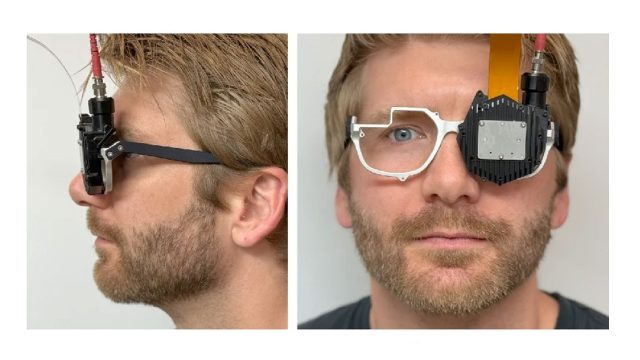
Researchers at Meta Actuality Labs and Stanford College have unveiled a brand new holographic show that would ship digital and blended actuality experiences in a type issue the scale of normal glasses.
In a paper revealed in Nature Photonics, Stanford electrical engineering professor Gordon Wetzstein and colleagues from Meta and Stanford define a prototype system that mixes ultra-thin {custom} waveguide holography with AI-driven algorithms to render extremely lifelike 3D visuals.
Though primarily based on waveguides, the system’s optics aren’t clear such as you may discover on HoloLens 2 or Magic Leap One although—the explanation why it’s known as a blended actuality show and never augmented actuality.
At simply 3 millimeters thick, its optical stack integrates a custom-designed waveguide and a Spatial Gentle Modulator (SLM), which modulates mild on a pixel-by-pixel foundation to create “full-resolution holographic mild discipline rendering” projected to the attention.
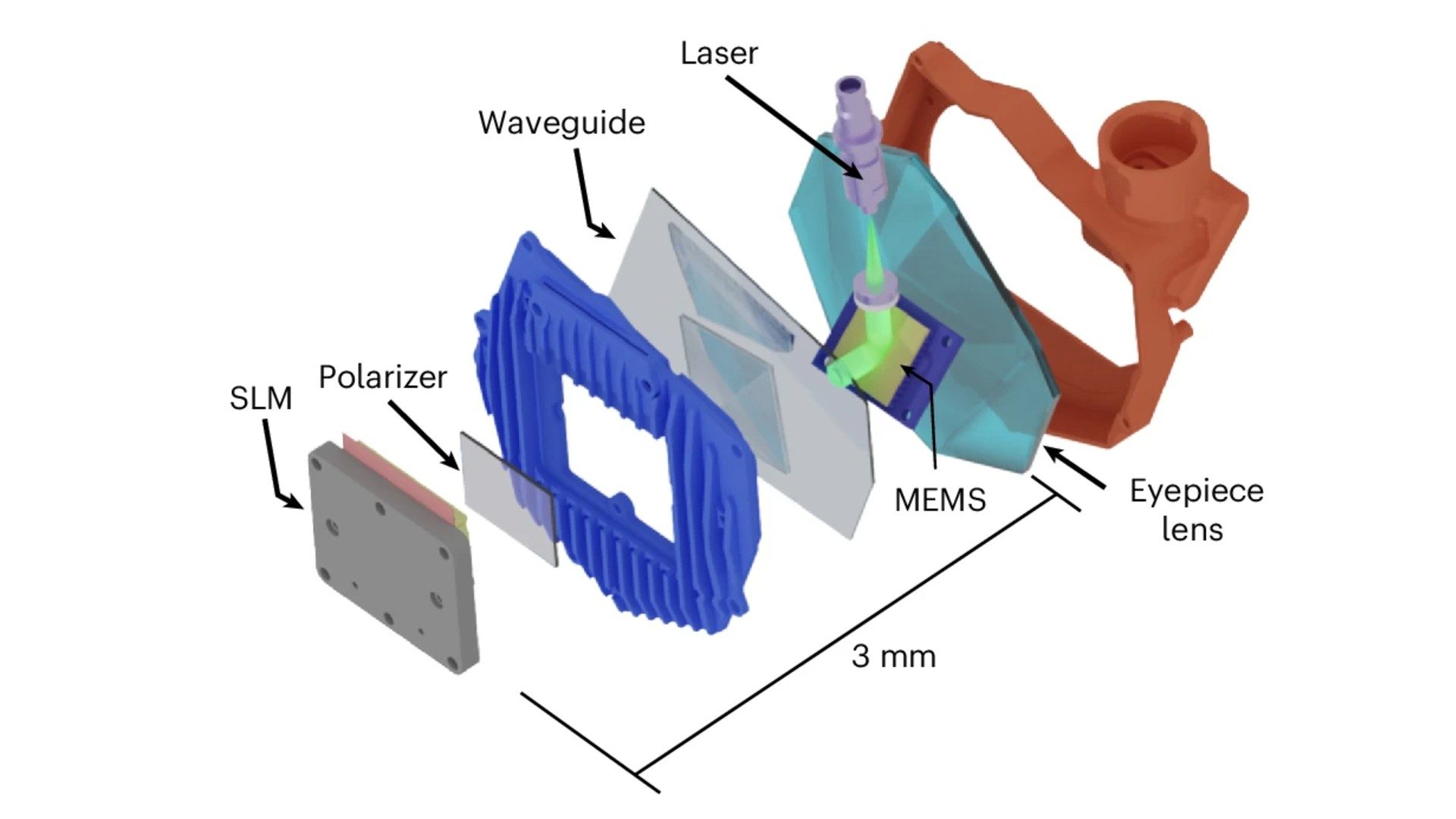
Not like conventional XR headsets that simulate depth utilizing flat stereoscopic pictures, this technique produces true holograms by reconstructing the complete mild discipline, leading to extra lifelike and naturally viewable 3D visuals.
“Holography gives capabilities we are able to’t get with some other kind of show in a bundle that’s a lot smaller than something available on the market at this time,” Wetzstein tells Stanford Report.”
The concept can be to ship lifelike, immersive 3D visuals not solely throughout a large field-of-view (FOV), but in addition a large eyebox—permitting you to maneuver your eye relative to the glasses with out shedding focus or picture high quality, or one of many “keys to the realism and immersion of the system,” Wetzstein says.
The rationale we haven’t seen digital holographic shows in headsets up till now could be as a result of “restricted area–bandwidth product, or étendue, supplied by present spatial mild modulators (SLMs),” the crew says.
In follow, a small étendue essentially limits how giant of a discipline of view and vary of potential pupil positions, that’s, eyebox, could be achieved concurrently.
Whereas the sector of view is essential for offering a visually efficient and immersive expertise, the eyebox measurement is vital to make this expertise accessible to a variety of customers, overlaying a variety of facial anatomies in addition to making the visible expertise sturdy to eye motion and system slippage on the consumer’s head.
The venture is taken into account the second in an ongoing trilogy. Final yr, Wetzstein’s lab launched the enabling waveguide. This yr, they’ve constructed a functioning prototype. The ultimate stage—a business product—should be years away, however Wetzstein is optimistic.
The crew describes it as a “important step” towards passing what many within the discipline discuss with as a “Visible Turing Take a look at”—basically the flexibility to now not “distinguish between a bodily, actual factor as seen by means of the glasses and a digitally created picture being projected on the show floor,” Suyeon Choi mentioned, the paper’s lead writer.
This follows a current reveal from researchers at Meta’s Actuality Labs that includes ultra-wide field-of-view VR & MR headsets that use novel optics to keep up a compact, goggles-style type issue. As compared, these embody “high-curvature reflective polarizers,” and never waveguides as such.
The publish Meta & Stanford Reveal Extremely-Skinny Holographic XR Show the Dimension of Glasses appeared first on Street to VR.