
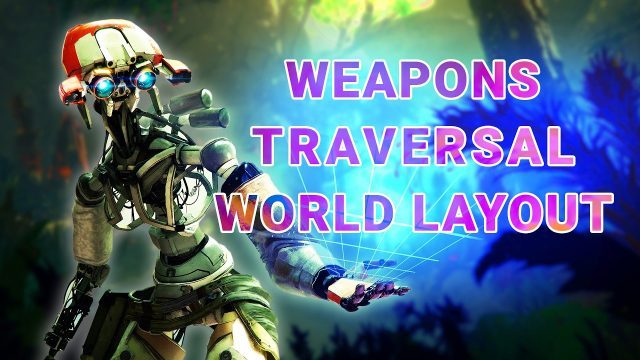
Our collection Inside XR Design examines particular examples of nice immersive design. As we speak we’re wanting on the intelligent design of Stormland’s weapons, multi-modal locomotion, and open-world.
Editor’s Observe: Stormland was launched six years in the past in the present day! In celebration of the its launch anniversary, we’re bumping this episode of Inside XR Design again as much as our entrance web page to focus on the sport’s intelligent strategy to weapons, multi-modal locomotion, and its distinctive open-world structure. Regardless of its age, there’s nonetheless heaps to be taught from Stormland’s considerate design.
You could find the entire video under, or proceed studying for an tailored textual content model.
Stormland is an open-world action-adventure recreation with co-op help from Insomniac Video games. It’s obtainable on Oculus PC (playable on SteamVR headsets through Revive); take a look at our full evaluate right here.
By the point the studio started growth on Stormland, it had already constructed three VR video games prior. That have reveals by clearly in a lot of Stormland’s cleverly designed techniques and interactions.
On this article we’re going to discover the sport’s distinctive tackle weapon reloading and stock administration, its use of multi-modal locomotion, and its novel open-world design. Let’s begin with weapons.
Weapons
Like many VR video games, one of many main modes of interplay in Stormland is between the participant and their weapons. For probably the most half, this works such as you’d count on: you pull your gun out of a holster, you may maintain it with one hand or two, and also you pull the set off to fireplace. However when your gun runs out of ammo, you do one thing completely different than we see in most VR video games… you rip them in half.
Ripping weapons aside provides you each ammo for that weapon kind and crafting supplies that are used to improve your weapons and skills within the recreation. In that sense, this gun-ripping pulls double-duty as a method to replenish ammo and gather helpful sources after a battle.
Most gun video games in VR use magazines to replenish a weapon’s ammo, and whereas this may definitely work nicely and really feel practical, it’s additionally pretty advanced and liable to error, particularly when the participant is below strain.
Dropping {a magazine} to the bottom in the midst of a firefight and needing to bend over to choose it up may really feel cheap in a slower-paced simulation recreation, however Stormland goals for a run-and-gun tempo, and subsequently opted for a reloading interplay that’s visceral, enjoyable, and simple to carry out, regardless of which weapon the participant is utilizing.
This ‘ripping’ interplay, mixed with some nice visible and sound results, is actually enjoyable regardless of what number of occasions you do it.
Curiously, Stormland’s Lead Designer, Mike Daly, advised me he wasn’t satisfied when one of many recreation’s designers first pitched the thought for ripping weapons aside. The designer labored with a programmer to prototype the thought and ultimately bought Mike and the remainder of the staff on implementing it into the sport. They appreciated it a lot that they even determined to make use of the identical interplay for non-gun objects like well being and power canisters.
A streamlined strategy to weapon reloading isn’t the one factor that Stormland does to make issues simpler for the participant so as to keep a run-and-gun tempo; there’s additionally a really deliberate comfort added for weapon dealing with.
If dropping {a magazine} in the midst of a battle can harm the tempo of gameplay, dropping the gun itself can cease it outright. In Stormland, the designers selected to not punish gamers for by accident dropping their gun, by as an alternative having the weapon merely float in place for just a few seconds to provide the participant an opportunity to seize it once more with out bending down to choose it up from the ground.
And in the event that they merely go away it there the gun will kindly return to its holster. This can be a nice method to keep practical interactivity with the weapons whereas avoiding the issue of gamers dropping weapons within the warmth of fight or by by accident not holstering them.
Permitting the weapons to drift additionally has the additional advantage of constructing stock administration simpler. In case your weapon holsters are already full however you have to shuffle your weapons, the floating mechanic works virtually like a useful third-hand to carry onto objects for you when you make changes.
Multi-modal Locomotion
Locomotion design in VR is advanced due to the necessity to maintain gamers snug whereas nonetheless reaching gameplay objectives. Being an open-world recreation, Stormland wanted an strategy to locomotion that may permit gamers to maneuver giant distances, each horizontally and vertically.
As a substitute of sticking with only one strategy, the sport mixes distinct modes of locomotion and encourages gamers to modify between them on the fly. Stormland makes use of thumbstick motion if you’re on agency floor, climbing when you have to scale tall buildings, and gliding for big scale motion throughout the map.
Thumbstick motion works just about the way you’d count on, however climbing and gliding have some good design particulars price speaking about.
Climbing in Stormland works very equally to what you might have seen in different VR video games, with the exception that your hand doesn’t have to be immediately touching a floor so as to climb. You possibly can truly ‘seize’ the wall from a number of toes away. This makes it simpler to climb shortly by requiring much less precision between hand placement and grip timing. It additionally retains the participant’s face from being proper up towards the wall, which is extra snug, and means they don’t must pressure their neck fairly as a lot when wanting up for his or her subsequent hand-hold.
After which there’s Stormland’s gliding locomotion which lets gamers shortly journey from one finish of the map to a different. This quick motion looks like it might be a recipe for dizziness, however that doesn’t appear to be the case—and I’ll speak extra about why in a second.
With these three modes of locomotion—thumbstick motion, climbing, and gliding—Stormland does a superb job of constructing gamers really feel like they’re free to fluidly transfer wherever they need and at any time when they need, particularly due to the way in which they work in tandem.
VR-centric Open World Design
Open world VR video games are very difficult to make as a result of filling an enormous map with fascinating issues to do is extraordinarily useful resource intensive for builders—to not point out that slowly strolling lengthy distances in VR is never that a lot enjoyable. However feeling such as you’re exploring a big surroundings is a key a part of the open-world style.
Stormland got here up with a genius compromise which supplies gamers the sensation of exploration with out anticipating them to stroll for minutes at a time with nothing to do. The sport achieves this by representing its points-of-interest as literal islands, after which spreading them far aside whereas giving gamers a quick and enjoyable method to navigate between them. All through the sport gamers are given upgrades that make their traversal expertise much more enjoyable, like the flexibility to create a ramp within the clouds to launch themselves onto an island.
Most VR video games by no means transfer the participant as quick as Stormland’s cloud gliding. Upon first seeing it you may understanbly assume there’s no means it might be snug. Nevertheless it seems to be very snug, and that’s thanks to some intelligent methods. First, let’s speak about vection.
Vection is the sense of movement implied by what’s in your visible subject. Usually after we’re transferring by the world we visually see issues transferring previous us and this aligns with the remainder of our physique’s senses of movement. In VR, in case you have a lot of movement in your visible subject however your physique’s different senses assume you’re static, the battle between these sensations can result in dizziness.
That’s why VR video games the place you solely stand nonetheless are usually completely snug, whereas video games with a lot of movement could be dizzying.
So as to keep consolation, Stormland is cautious to keep away from extreme vection when utilizing high-speed locomotion. It does this by minimizing the quantity of fast paced imagery throughout your visible subject.
The sport’s quick motion is barely accessible on the clouds; which means that solely the decrease a part of your visible subject is transferring shortly, and even then, the flat, low distinction texture of the clouds reduces the sense of vection. However, having timber whizzing previous the participant’s head for too lengthy would result in important vection and doubtlessly dizziness.
One other key consolation trick is that the high-speed gliding is managed not with the thumbstick, however together with your arms. Stormland’s Lead Designer, Mike Daly, advised me that this was a really intentional selection. Bodily involving the participant’s physique in locomotion has been constantly demonstrated to be extra snug than the identical locomotion with much less bodily involvement. Each pace and route whereas gliding are managed by how far the participant outstretches their arms and which route they level them.
There’s a lot extra nice VR design to be present in Stormland, however that’s all for in the present day—possibly we’ll revisit the sport sooner or later.
Loved this breakdown? Try the remainder of our Inside XR Design collection and our Insights & Art work collection.
And if you happen to’re nonetheless studying, how about dropping a remark to tell us which recreation or app you assume we should always cowl subsequent?
The submit VR Design Unpacked: This 2019 Sport Nonetheless Units the Bar for Open World VR appeared first on Highway to VR.