
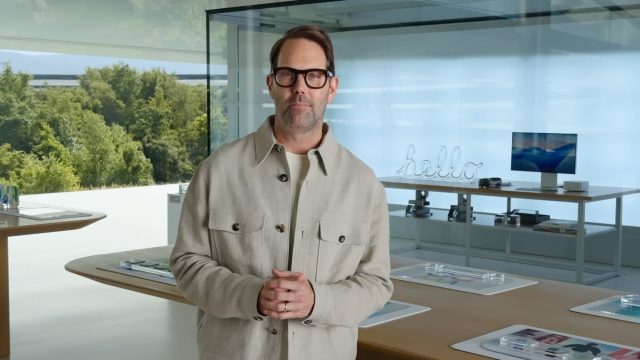

Apple’s Vice President of Human Interface design, Alan Dye, is leaving the corporate to guide a brand new studio inside Meta’s Actuality Labs division. The transfer seems to be geared toward elevating the bar on the person expertise of Meta’s glasses and headsets.
The Information
In response to his LinkedIn profile, Alan Dye spent almost 20 years as Apple’s Vice President of Human Interface Design. He was a driving pressure behind the corporate’s UI and UX route, together with Apple’s most up-to-date ‘Liquid Glass’ interface overhaul and the VisionOS interface that’s the inspiration of Imaginative and prescient Professional.
Now Dye is heading to Meta to guide a “new inventive studio inside Actuality Labs,” based on an announcement by Meta CEO Mark Zuckerberg.
“The brand new studio [led by Dye] will deliver collectively design, trend, and know-how to outline the following era of our merchandise and experiences. Our concept is to deal with intelligence as a brand new design materials and picture what turns into doable when it’s considerable, succesful, and human-centered,” Zuckerberg stated. “We plan to raise design inside Meta, and pull collectively a gifted group with a mix of craft, inventive imaginative and prescient, methods pondering, and deep expertise constructing iconic merchandise that bridge {hardware} and software program.”
The brand new studio inside Actuality Labs can even embrace Billy Sorrentino, one other excessive stage Apple designer; Joshua To, who has led interface design at Actuality Labs; Meta’s industrial design crew, led by Pete Bristol; and artwork groups led by Jason Rubin, a longtime Meta govt that has been with the corporate since its 2014 acquisition of Oculus.
“We’re getting into a brand new period the place AI glasses and different units will change how we join with know-how and one another. The potential is gigantic, however what issues most is making these experiences really feel pure and actually centered round individuals. With this new studio, we’re centered on making each interplay considerate, intuitive, and constructed to serve individuals,” stated Zuckerberg.
My Take
I’ve been ranting concerning the elementary problems with the Quest person expertise and interface (UX & UI) for actually years at this level. Meta has largely hit it out of the park with its {hardware} design, however the software program facet of issues has lagged far behind what we’d anticipate from one of many world’s main software program corporations. A publish on X from lower than a month in the past sums up my ideas:
It’s loopy to see Meta take one step ahead with its Quest UI and two steps again, again and again for years.
They hold piling on new options with seemingly no top-down imaginative and prescient for a way the interface ought to work or really feel. The Quest interface is as scattered, complicated, and unpolished as ever.
The brand new Navigator is an enchancment for merely accessing app icons, however it feels prefer it’s utilizing a very completely different paradigm than the remainder of the window / panel administration interface. To not point out that the system interface speaks a vastly completely different language than the Horizon interface.
I’ve fully misplaced religion that Meta will ever get a deal with on this after watching the interface meander in random instructions yr after yr, punctuated by “refreshes” that look promising however find yourself being forgotten about 6 months later.
It appears Meta is attempting to course-correct earlier than issues get additional out of hand. If pulling in one of many world’s most skilled people at creating cohesive UX & UI at scale is what it takes, then I’m glad to see it occurring.
Apple has set a excessive bar for a way simple a headset needs to be to make use of. I exploit each Imaginative and prescient Professional and Quest frequently, and transferring between them is a night-and-day distinction in usability and polish. And as I’ve stated earlier than, the excessive price of Imaginative and prescient Professional has little to do with why its interface works so significantly better; the excessive stage design choices—which might work equally properly on any headset—are a way more important issue.
Again when Meta was nonetheless referred to as Fb, the corporate had a well-known motto: “Transfer quick and break issues.” Though the corporate now not champions this motto, it looks as if it has had a tough time leaving it behind. The scattered, unpolished, and continuously shifting nature of the Quest interface may hardly embody the motto extra clearly.
“Transfer quick and break issues” might need labored nice on the earth of net improvement, however in relation to creating a very new interface paradigm for the model new medium of VR, it hasn’t labored so properly.
After all, Dye’s onboarding and the brand new studio inside Actuality Labs isn’t solely about Quest. In reality, it won’t even be largely about Quest. If I’ve realized something about Zuckerberg over time, it’s that he’s a really long-term thinker and does what he can to maneuver his firm the place it must go to be in the suitable place 5 or 10 years down the street.
And in 5 to 10 years, Zuckerberg hopes Meta might be dominant, not simply with immersive headsets, however AI sensible glasses (and sure unreleased units) too. This new crew will possible not be centered on fixing the present state of the Quest interface, however as an alternative attempting to outline a cohesive UX & UI for the corporate’s total ecosystem of units.
With Alan Dye heading to Meta, there’s probability that he’ll deliver with him many years of Apple design processes which have labored properly for the corporate over a few years. However I’ve a sense will probably be a major problem for him to vary “transfer quick and break issues” to “transfer gradual and polish issues” inside Meta.
The publish Apple Design Lead Heads to Meta, Hopefully to Repair Longstanding Quest UX Points appeared first on Street to VR.