
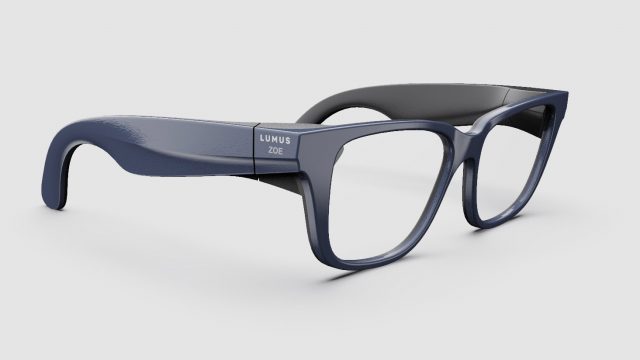
Lumus, the corporate that developed the waveguide optic utilized in Meta’s Ray-Ban Show good glasses, says it has achieved a 70° field-of-view in a brand new design revealed this week at CES 2026. This conveniently matches the 70° field-of-view that Meta achieved in its ‘Orion’ prototype, however solely with the usage of novel supplies.
The Information
Again in 2024, Meta revealed its first AR glasses prototype, codenamed Orion. One of many prototype’s large improvements was its means to squeeze a 70° field-of-view into such a small form-factor. This was made attainable with the usage of distinctive waveguide optics made with silicon carbide, a novel materials that enabled the broader field-of-view because of its higher refractive index.
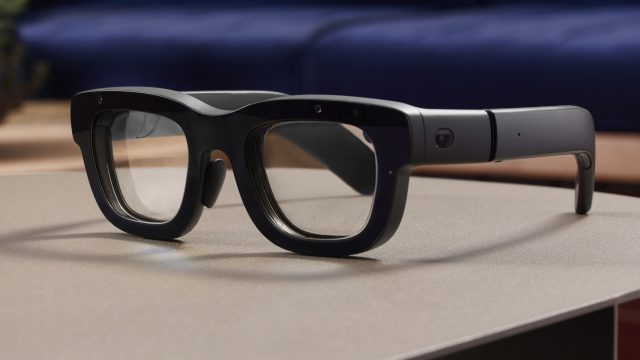
In 2025, Meta talked concerning the challenges of producing silicon carbide waveguides, affordably, at scale. Whereas the corporate stated progress was being made, it nonetheless conceded that the work is ongoing.
“We’ve efficiently proven that silicon carbide can flex throughout electronics and photonics. It’s a cloth that might have future functions in quantum computing. And we’re seeing indicators that it’s attainable to considerably scale back the fee. There’s quite a lot of work left to be finished, however the potential upside right here is big,” the corporate stated on the time.
However now Lumus, the corporate that developed the waveguides in Meta’s Ray-Ban Show glasses says it has achieved a 70° field-of-view in its glass waveguides. The corporate claims it’s the “world’s first geometric waveguide to surpass a 70° FOV.”
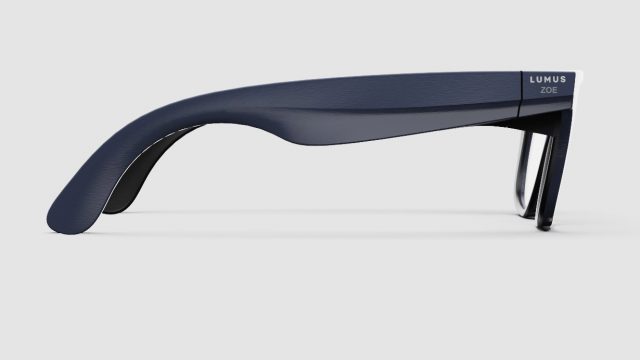
The corporate introduced that it’s exhibiting the brand new ZOE waveguide this week at CES 2026. Renders offered by the corporate present the corporate’s newest prototype to incorporate the ZOE optics (although it’s value noting that Lumus’ prototypes usually don’t embrace on-board battery, compute, or monitoring {hardware}, which might add bulk to any actual product primarily based on ZOE).
My Take
My intestine tells me it in all probability isn’t a coincidence that Lumus has been aiming for a 70° field-of-view, which simply occurs to match what Meta achieved with its Orion prototype. Most certainly, the corporate was tasked (implicitly or possibly even immediately) with doing precisely that—proving that its waveguides may attain the 70° benchmark with out utilizing silicon carbide.
Past merely attaining a 70° field-of-view as a proof-of-concept, Lumus says the ZOE optic is made with the identical course of as its different glass waveguides. That’s an enormous deal, as a result of the corporate has already confirmed that such waveguides will be manufactured at scale, because of the usage of its waveguides in Ray-Ban Show, Meta’s first good glasses with a show.
Which means Lumus’ ZOE waveguide is most positively on the shortlist for what Meta may use in its first pair of large field-of-view AR glasses, which the corporate stated it hopes to convey to market earlier than 2030.
Granted, field-of-view isn’t the whole lot. With regards to optics, the whole lot is a tradeoff. Elevated field-of-view can impression brightness, PPD, and varied visible artifacts. With out with the ability to see the brand new ZOE optic for myself, it’s exhausting to say whether or not or not Lumus has one thing really new right here, or in the event that they’ve merely boosted field-of-view by buying and selling different downsides.
I anticipate I’ll have an opportunity to see the ZOE optic later this yr at AWE 2026 the place I often meet with Lumus to see their newest developments. Within the meantime, I’ve additionally reached out to the corporate to study extra about the way it reached the 70° field-of-view and what tradeoffs it did or didn’t need to make to get there.
The submit Meta Waveguide Supplier Claims “world’s first” 70° FoV Waveguide appeared first on Street to VR.